Posts

Showing posts with the label India

The Indian economic development in a nutshell

I recently started to write a book and I will publish parts in the coming months on this blog. The working title of the book will be:  Orchestrating the IT value chain and provides my experience and vision on improving the performance of IT and alignment with the business. This blog is about the effects globalisation had on the country I lived in for an year: India. After the fall of the Berlin Wall, countries such as India, China and Russia began to open up their economies to the world. This enhanced collaboration across the globe and kick started an unprecedented economic growth within India. Until the 1980s, Indian policy makers enforced a strict industry policy which resembled in many ways the ‘plan economies’ of communistic countries. By nationalizing companies and regulating the amount of output a company or industry could produce, the government tried to develop the country from a society of farmers to an industrialized country. In line with this policy imposed the g...
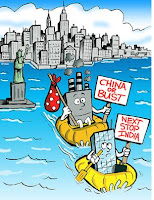
Can China and India sustain its position as an attractive destination, part 2

Image
In this post I discussed how tolerance of a people influences the overall development of a country and thus also its attractiveness as an outsource/ captive destination. This article explores a bit the history behind the exclamations that this is the ‘Century of Asia’ and what this again means for Asia as a destination to offshore activities to. First remark regarding the exclamation is that there is no homogenous Asia. Asia is a continent and countries within it develop at different speeds. Vietnam is not China and The Philippines not Cambodia. Second remark to this is that the ‘Century of Asia’ was for the first time exclaimed in 1905 by the Japanese when they defeated the Russians in a famous naval battle. The second time the term was used was in 1911 when nationalists overthrew the Chinese Empire. After Mao kicked the nationalists out in 1956 there was another opportunity for Asia to become more prominent, but mess ups by the communist government (e.g. Great Leap Forward, cultura...

Can China and India sustain its position as an attractive destination, part 1

There were two publications in the Dutch newspaper NRC which caught my attention as they are relevant from a sourcing perspective. One of the articles was about why the United States is a ‘hyper power’ and why China is unlikely to become that anytime soon and the other one about the rise of Asia in general. I will briefly discuss the core of both articles and discuss their relevance to Asia as a destination for outsourcing and setting up shared service centres/captives. Amy Chua (professor at Yale University) investigated how countries become so called ‘hyper powers’ and than fall. She investigated the rise and fall of the Roman empire, Persian empire, Tang empire in China, Mongolian empire, Dutch empire and the English empire. The main finding of her is that tolerance towards people with other believes and culture is one of the main preconditions to become a hyperpower. One of the reasons the United States was/is a hyperpower is their tolerance towards its inhabitants and importing ...

Is the mighty Chinese dragon threatening the Indian outsource suppliers?

Image
I get positive signs from clients and research firms (even though I am a bit sceptical on their reports, see here ) on the performance of various Indian suppliers. They continue to mature and this also helps them to penetrate the continental European market further. Why? One of the differences I see between American outsourcing engagements and European/Dutch projects is that in America it is not uncommon to have a contract stating the scope as “50 IT employees performing network management”. The company basically hires resources and maybe somewhere in the future the contract changes into a more sophisticated model where the client demands certain functionalities and quality levels (e.g. providing 100Mb network bandwidth to desktops with a response time of X and an availability of Y for price $$ per connection). In The Netherlands at least (and I think the same applies for Germany and France) we typically start with the second type of ‘service description’. We focus here less on resourc...