Posts

From procurement function to sourcing function

Procurement as a business discipline has matured over the past few decades. The times are over of procurement as an intermediary functions that records agreements with suppliers and supervises their fulfilment. That is too limited a view in today’s business environment, where management is confronted with a multitude of issues impacting on the role and responsibilities of procurement.   It has been recognised that an effective and efficient procurement function can significantly contribute to business’ bottom line: competitive financial result. What’s more, many organisations feel the need to improve their relationships with suppliers in order to be better able to reduce costs, improve quality, increase flexibility and boost innovation in order to survive. Especially in these challenging economic times where outsourcing is used as a means to cut cost quickly is it necessary to move away from the traditional role of procurement as an intermediary functions that records agreement...
Will offshoring harm Western service economies?

"Restoring American Competitiveness" is an article from Gary Pisano and Willy Shih in the juli/august issue of Harvard Business Review. The article points out that, against the general consensus, American companies will be unable to develop the next generation high tech products due to underestimating the impact of sending their manufacturing offshore. If this is true, can similar effects be expected for the service industry? In other words: will Western countries not only have to fight an uphill battle in manufacturing, but soon also in services? The article in HBR uses the value chain of personal computers and laptops as an example. Where American companies like HP, Dell and Compaq outsourced initially only their manufacturing to low cost offshore destinations, is now almost the whole industry based in Asia. Every laptop sold by an American brand, with the exception of Apple, is today designed, developed and manufactured outside the U.S.. The same applies to most phones a...

CMMi for aquisitions versus eSCM, ISPL and other standards, part 2

In the previous post related to this topic I wrote some of my thoughts on CMMi for acquisitions and ISO/IEC 12207.These two plus ISPL are models which can be used to structure an outsourcing process. The aim of these models in a nutshell is providing the client organisation with: the right service/product, for the best price, at the desired quality levels, from the best vendor, at or within the risk appetite of the company. The three models mentioned in these posts scratch only the surface of (proprietary) models which can be used to structure an outsource process. For those situations where these models are too complex, ISO 9001:2008 could be of help as purchasing is one of the processes addressed. The purchase process described consists of three sub-processes: supplier evaluation (section 7.4.1), purchase orders (section 7.4.2) and goods receipts checks (7.4.3). CMMi for acquisitions and ISO/IEC 12207 were addressed in the previous post, but not ISPL. ISPL stands for Information Serv...

Which Chinese Service Providers are out there?

In this post I wrote on the rise of the Chinese IT service providers which could be the new kids on the block and give established Indian service providers a run for their money. Here I want to provide some insights on the Chinese supplier market of IT services. Feel free to add any comments if you feel that I missed out some vital information. One way established service providers deal with the Chinese ‘treat’ is partnering with them, like Yucheng Technologies and Convergys. Yucheng is a China-based IT solution provider and Convergys a U.S. based provider of customer and employee relationship management solutions. As per the agreement, Yucheng Technologies will sell Convergys' Intervoice Edify Voice Interaction Platform (EVIP) and Convergys Dynamic Decisioning Solutions in the Chinese market. I wonder however whether this is a smart move in the long term. Like with the car industry did Chinese companies learn how to make cars by partnering with Western car manufacturers. Especiall...

Reducing the cost of regulatory compliance for outsource contracts, part 3

Image
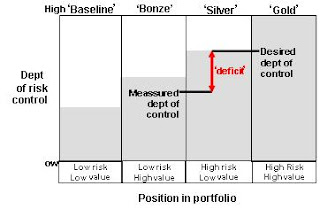
This post is the third in a row in which I write on a methodology I created to improve the effectiveness and efficiency of managing regulatory risk when outsourcing. The first two posts are here and here . Below I write on translating the risk/value ratio’s of the outsource contracts into the optimum control strategy. The starting point is the contract portfolio in which the value and compliance risk of the outsource contracts are plotted. The position drives among others the resources spend by the compliance function on monitoring a contract. The control and monitor activities are typically described in a so called Compliance Program which is the overarching framework that encompasses the different activities and responsibilities performed by the compliance function. Compliance cost can be reduced further by applying only a ´golden´ control and monitoring approach when it is really necessary (for example at high risk and value) and select a ´silver´ or ´bronze´ approach elsewhere (se...

Outsourcing risk and Madoff

Image
One of the key issues of the financial crisis was banks not knowing the value of their assets. This lack of insight has numerous reasons, but to me the main ones are: too much focus on short term profit, not being able to understand your own financial products anymore and inadequate control over your back-end business partners. In this post I want to put some of my thoughts on this last topic: the importance of monitoring the ‘health’ of the other financial institutions the bank does business with. Banks got hit by Madoff and Leman Brothers because they did not appreciate the risk they ‘imported’ by extending their value chain beyond their own borders. This issue was broad to my attention again in n a recent interview of Z24 (Dutch internet news channel) with the Chief Risk Officer of Fortis Bank Netherlands (3 billion revenue 2008, 184 billion in assets. In this interview the risk management practises of the bank were discussed and the CRO stated that the board is closely involved wi...

Reducing the cost of regulatory compliance for outsource contracts, part 2

Image
In the previous post on this topic I wrote that the control framework created by compliance functions within financial institutions for outsource contracts are often inadequate and too expensive. The main reasons for these observations are that compliance officers often do not understand enough the scope and dynamics of the contract in order to create a lean but adequate compliance chart. By requiring all regulations to be in-scope they hope not to miss out on anything. Furthermore are compliance officers not trained well enough in translating an internal control framework into an external one. This often results in either requiring the vendor to copy the internal control framework of the bank (very expensive option as the bank does not leverage on the best practises of the vendor) or they just resort to letting the vendor sign a yearly ‘in contol’ statement (too simple as the vendor mostly does not know what it signs for). My third reason for the initial statement was that compliance...